
In this guest post, Aaron Childree discusses research and findings of the recent article in Environmental Politics – Polarizing figures in polarized times: presidential involvement and public opinion on climate policy
The signing of the Paris Climate Agreement in 2016 represented a significant step forward in the fight against climate change, with more than 170 nations formally committing to the goal of keeping temperature increases below 2 degrees Celsius. However, as President Obama celebrated the US commitment to the Agreement, he had no idea just how short-lived that pledge would be.
“Today, the world meets the moment,” President Obama said in his 2016 remarks from the White House Rose Garden, which has since been paved over by the Trump administration. “And if we follow through on the commitments that this agreement embodies, history may well judge it as a turning point for our planet.”
Less than a year after that celebratory moment, the United States would become the first (and so far only) nation to go back on that commitment when President Donald Trump withdrew from the Agreement during his first term. Since then, US involvement in the international agreement has been subject to the political winds, with Biden recommitting the nation to its goals during his presidency and Trump again withdrawing at the start of his second term.
The fate of the Paris Agreement points to presidential politics as a key factor in the landscape of climate policy in the US. It’s this significant role of the president that led me to research the ways presidential involvement impacts how the public evaluates support for policies to combat the climate crisis.
In many cases, Presidents have wide latitude to implement public policy on their own, without working through Congress, and in the area of climate policy, there are two primary ways presidents do this—either through international agreements, such as the Paris Climate Agreement, or through their authority over executive branch agencies. I focus my research on examples of both of these avenues for presidential action by examining public support for the aforementioned Paris Agreement along with the Environmental Protection Agency’s regulation of carbon emissions. How does action on these policies by the president shift how members of the public evaluate their support for the policies?
I find that the involvement of the president in climate policy tends to increase the partisan divide in public support for these policies. In recent years, climate policy has consistently been polarized by political party, with Democrats showing support at much higher levels than Republicans. However, when the president gets involved, this gap in public support between Democrats and Republicans increases even further.
This appears to happen for two reasons. First, because the president is the most visible politician in the US, presidential involvement increases the prominence of an action, which makes people more likely to hear about that action. For committed Democrats and Republicans, this will then make them more likely to receive information on their party’s position on the issue.
Second, because the president is also a well-known partisan figure, when the president themselves is directly associated with a policy, it increases the chances that people will view that policy through a partisan lens. If a Democratic president takes action, Republicans will tend to line up in opposition to that action. If a Republican president acts, Democrats will then be more likely to oppose the action.
The figure below illustrates a key part of this logic. The left side of the plot shows the expected level of support for the Paris Agreement among Democrats (blue square) and Republicans (red circle) taken from a 2017 poll conducted by the Chicago Council on Global Affairs. The right side shows the expected level of opposition to President Trump’s 2017 decision to withdraw from the Paris Agreement, using the data from a poll conducted by NPR and Marist College. The key difference between the two polls is that the first asks about support for the Agreement in general terms, while the second mentioned President Trump by name and asks about a specific action he took.
Expected Support for Paris Agreement, President Named vs. Not Named
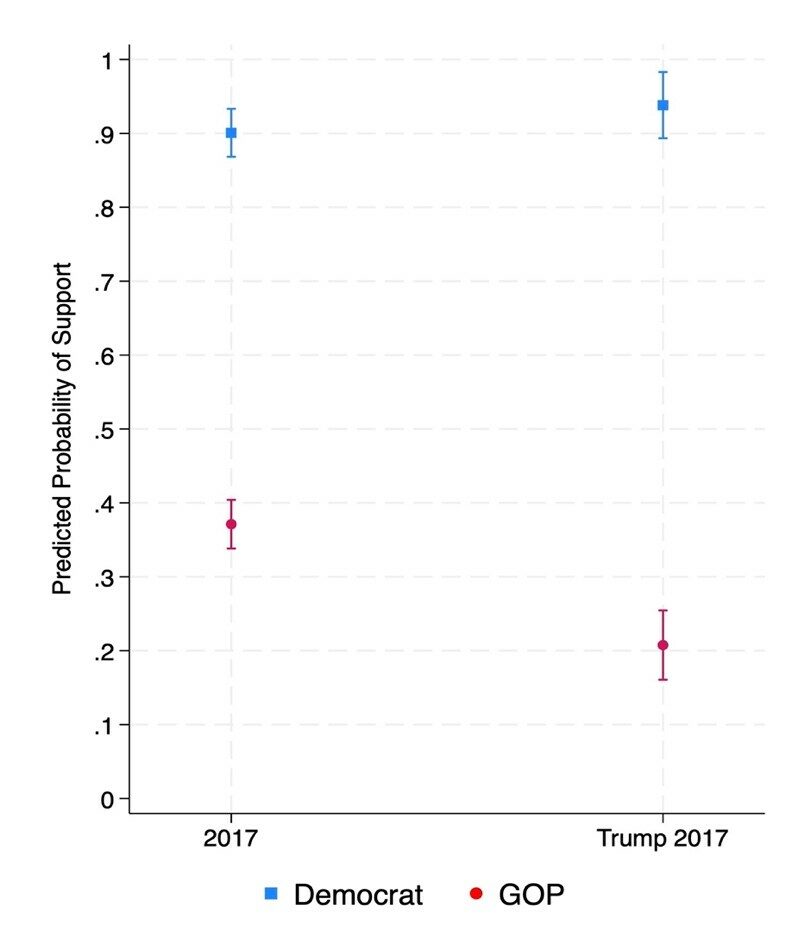
As the figure shows, the gap between Democratic and Republican support is large for both questions, but it is significantly larger for the question that mentions Trump by name and asks about his withdrawal. This is largely due to the drop in Republican support when Trump is named. While the expected level of support among Republicans in the question that asked about the Paris Agreement generally is 37 percent, that number drops to 21 percent when looking at the level of Republican opposition to Trump’s withdrawal. By contrast, the expected level of support for Democrats is 90 percent or above in both polls.
These findings unfortunately aren’t great news for those of us who hope for a strong response to the climate crisis from the US national government. In most circumstances, implementing durable policies to mitigate climate change will require building bipartisan support, which tends to be hindered anytime there is highly visible policy changes associated with the president. Even beyond that, recent Supreme Court decisions have virtually eliminated the Environmental Protection Agency’s ability to implement regulations on carbon emissions, closing down one of the paths for change included in my analysis.
Still, the idea that one of the drivers of high partisan polarization on climate policy is the involvement of the president points to potential avenues for minimizing partisanship in public support for climate change mitigation.
First, action to combat climate change at the state and local levels may not exhibit the same level of polarization in moments of highly visible action. Governors tend to have higher approval ratings than presidents and other national leaders, so the polarizing effects associated with presidents may not be as strong for state-level executives. There is also more variation in climate policy among Republican governors and local leaders. While President Trump, in both his first and second terms, has rolled back important environmental regulations, not all of his party’s governors have taken the same approach. For example, while Republican Doug Burgum is far from a staunch supporter of climate change mitigation, when he was governor of North Dakota, he put forward a plan for the state to become carbon neutral by 2030.
Still, there are relatively few examples of Republican state and local action to combat climate change. Even beyond that, state-level policies will not be enough to address climate change on their own. The climate crisis will necessitate a response at the national and international levels as well. In this regard, it is worth exploring whether having federal government officials other than the president take the lead on advocating for national policies might bypass the effects revealed in my study of presidential involvement. For example, if a cabinet secretary took the lead, would this mitigate the increases in partisan polarization I find when examining the president? What if a high-ranking diplomat promoted the next international climate agreement?
There is no guarantee that these methods would lead to higher levels of support—it isn’t much of a stretch to make the connection between the secretary of a cabinet agency or diplomat and the president—but this approach of finding a messenger other than the president is still a worthy topic for further investigation as it decreases the direct association of the president with the policy.
Finally, while my research finds that public opinion on climate policy is highly polarized by political party, it also shows that it is far from immovable. The level of public support for presidential policies on climate change changes along with predictable factors such as how much mainstream news outlets cover an action by the president and whether the president is directly associated with the policy. At a moment when the possibility of enacting large-scale climate mitigation policies in the US can feel like it is slipping through our grasp, and in an era in which extreme partisanship permeates our politics, it can be helpful to remember that people still can—and still do—change their minds.
Bio

Aaron Childree is a PhD Candidate in the Department of Government at Cornell University. In the fall of 2026, he will start as an Assistant Professor of Political Science at the University of Richmond. Aaron researches and teaches on US politics, with a focus on the presidency, including presidential climate policy, as well as interbranch relations, democratic backsliding, and the domestic politics of foreign affairs.
