
In this guest post, Ariel Paz-Sawicki discusses research and findings of the recent article in Environmental Politics – Are liberal democracies immune to the democratic resource curse?
When Israel’s finance minister Yuval Steinitz wanted to impose a windfall tax on the profits of the natural gas fields discovered offshore in 2009–2010, he faced a massive pressure campaign from the gas lobby. The campaign included dozens of former regulators hired by the industry (“revolving doors”), negative media coverage, and even pressure from the Obama Administration, that intervened on behalf of Texas-based Noble Energy, the owner-operator of the fields. Steinitz describes this in his memoir and interviews, asking rhetorically: “Will we submit to large corporations who exert massive pressure, including a strong US lobby, or is our democracy strong enough?”
Taxes were indeed raised in 2011, doubling the public’s share of resource profits; billions would go to the public rather than the corporations. This public victory was short-lived, however.
In 2015, the country’s competition commissioner, David Gilo, wanted to dissolve the gas monopoly that had been charging power plants high prices for natural gas, meaning higher electricity costs for the entire public. His proposed structural changes were thwarted: following intervention by Prime Minister Benjamin Netanyahu, the government adopted the Natural Gas Framework, which kept 90% of the gas in the hands of the gas monopoly and gas prices high. It seemed that by 2015, Israeli democracy was not strong enough after all.
In our latest article in Environmental Politics, Lior Herman and I delve into the Israeli natural gas case study, analysing it against the scholarship on the democratic resource curse, which debates whether an abundance of natural resources – particularly, petroleum – may have a detrimental effect on democratic institutions. The existing literature focuses on authoritarian states or transitional democracies, usually assuming that established liberal democracies are unaffected by resource discovery. Norway is often presented as evidence that strong institutions protect democracy and turn resources into sustainable growth. We challenge this view, hypothesising a mechanism by which democratic institutions are strained by resource discovery, even in liberal democracies.
In the Israeli case, the timeline raises the possibility of a connection between resource discovery and democratic decline. The major gas fields, discovered in 2009–2010, met an underdeveloped regulatory system, as Israel had no experience in petroleum production. The years 2010–2016 became critical in forming the regulatory framework, with intense debates, primarily regarding three key issues: taxation, export caps, and competition. These debates became targets of widespread lobbying by the gas industry. While the first two issues were settled in the public’s interest – raising taxes and limiting exports to ensure domestic supply – the competition question saw unprecedented intervention by the political leadership and especially PM Netanyahu, who circumvented independent regulators and pushed through pro-industry decisions, leaving the gas monopoly intact. Shortly after, Israel would experience increasing strain on its democratic institutions, culminating in the Netanyahu government formed in 2022, which targeted democratic institutions such as the courts, the news media, and civil society. In 2023, the V-Dem Institute downgraded Israel from a liberal democracy to an electoral democracy.
Figure 1: Israel – Liberal Democracy Index (VDEM) and gas production
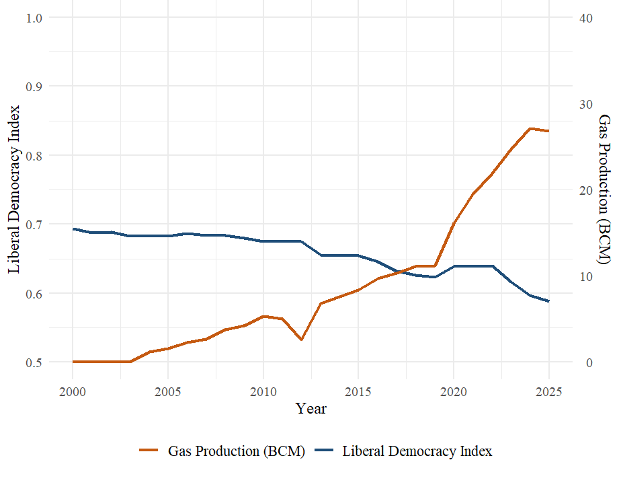
Are these developments connected? This is far from clear, as Israel has several other sources of strain on its democratic institutions, most notably the occupation of the Palestinian population, rising ultra-nationalism, and powerful religious institutions. While claiming that natural gas discovery caused democratic backsliding may be hard to prove, we suggest it may be an exacerbating factor, worsening existing trends. Specifically, we analyse the corrosive effect of the intense gas lobby on the bureaucracy and independent regulators, several of whom were ousted from their posts after opposing Netanyahu’s Gas Framework; as well as the capture of various media outlets by the industry through purchases, advertising campaigns, or other business ties. The picture we draw is of a subdued civil service that bows before an increasingly authoritarian prime minister, who bypasses various checks and balances, including norms guiding the role of parliament in regulatory pocesses, to push his agenda. As Netanyahu himself summarised when the Natural Gas Framework was passed: “When I want something, I get it.”
While this was unprecedented in the 2015 Gas Framework, political intervention in professional decision-making has increasingly become the norm in Israel’s civil service. As one interviewee described it, the politicisation of the Natural Gas Framework was the “small crack” that would spread across the civil service, strengthening political motives over professional priorities and public interests.
By dissecting a series of examples of the gas industry’s influence over media, regulators, and politicians, we explore and develop a hypothesis for how natural gas discovery may affect democratic institutions, even in liberal democracies. Rather than proving this link, we raise it as a possible exacerbating variable among several straining democracy. The following figure outlines this causal mechanism.
Figure 2: causal mechanism linking fossil fuel discovery and democratic decline
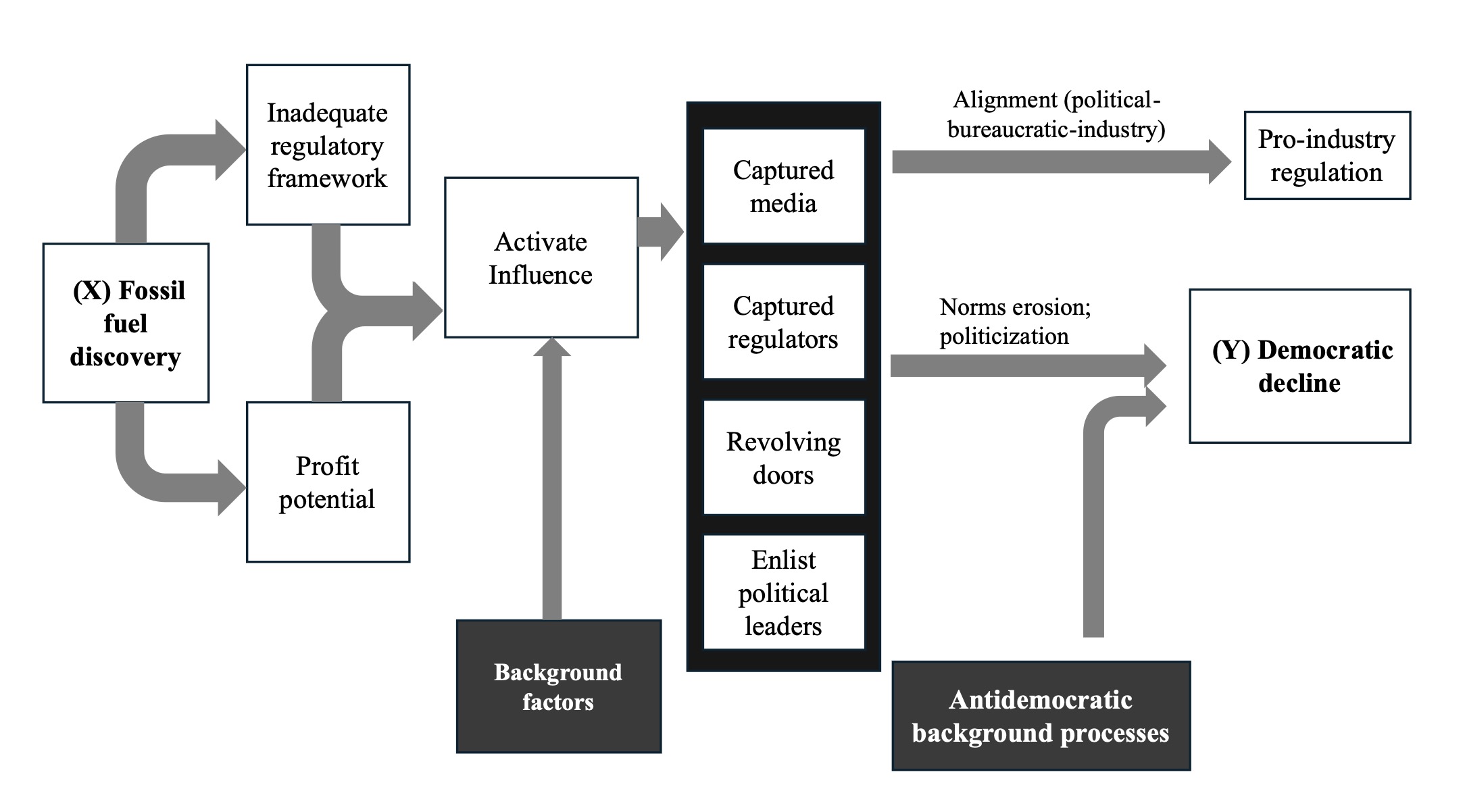
The evidence of this influence is varied. Drawing on 22 interviews with senior officials, regulators and industry figures, as well as extensive public sources (media, parliamentary session protocols, government documents), we identified 32 former public officials who moved into the gas industry, among them a former finance and energy minister, three oil and gas commissioners, and three competition commissioners. Gas owners also held stakes in, or business ties with, Israel’s two leading television channels and several major newspaper groups. Advertising allocation was used to bolster supportive media and punish outlets that refused to push the industry’s agenda.
Israel is unlikely to be unique. Fossil fuel influence networks have shaped climate and energy policy in Australia, and revolving doors between governments and the fossil fuel industry are common across OECD democracies. Liberal democracies already facing democratic backsliding that discover new resources may find their regulators, media and legislatures the target of similar influence campaigns.
The lesson is that strong institutions are not a permanent vaccine. They are precisely what industries whose profits depend on favourable regulations have the strongest incentive to bend, and the risk is greatest when large discoveries meet immature regulatory systems. Our next step is to test the mechanism more rigorously; we hope other scholars will ask similar questions about other cases.
Bio

Ariel Paz-Sawicki is a Ph.D. candidate at The Hebrew University of Jerusalem, in the faculty of Social Sciences, alongside his position as head of research for the Israeli consumer advocacy organization, Lobby 99.
