
In this interview, Antje Scharenberg and Chris Armstrong discuss the research and findings of their recent article in Environmental Politics: “Another ocean is possible”: thinking ocean justice beyond mastery.
Congratulations on your recent article! What is the key message that you hope people take from this publication?
We want to emphasise that there are a whole variety of ways of thinking about ocean justice. Some of them are compatible with what we might call “business as usual” in ocean politics, which is unfortunately tied to an extractivist model that is leading us to environmental ruin and different forms of oppression. Others are capable of presenting a challenge to that model. In particular, we are searching for conceptions of ocean justice which go beyond “mastery,” which is characterised by the drive to divide and subjugate. We suggest that one promising way to transcend mastery in our relationship with the ocean is to think about justice from the sea.
How did drawing a distinction between three justice tendencies (through the sea / for the sea / at sea) help you unpack ocean justice?
Our starting point for writing this article was a conversation we had back in 2023, which was published in Soundings – A Journal of Politics and Culture. A key move was to notice that prior conceptions of ocean justice tended to think about the ocean either in terms of environmental destruction, or in terms of socio-economic inequalities. This was unsatisfying to us, because the two issues are intimately connected. Ways of governing the ocean (and the earth more broadly) have produced injustices that are simultaneously environmental and socio-economic. So, a conceptual framework that separates those things off is unlikely to be politically helpful – it may even be harmful. We hoped that drawing out these three justice tendencies was conceptually useful, but also that it would help scholars and activists to transcend them.
You apply a decolonial critique to all three of these tendencies. What does this approach generate for you?
We found that a decolonial critique helped us better understand the underlying logic of governance that connects the three tendencies. This logic is one of mastery, and it lies at the heart of much of the inequalities and injustices we witness at sea – and on land for that matter. Decolonial scholars have long shown, for instance, how the domination of planet and specific groups of people are intimately connected. In writing this article, we were particularly inspired by Julietta Singh’s book Unthinking Mastery, as well as Malcolm Ferdinand’s Decolonial Ecology. Both show not only how mastery operates but also how masterful tendencies linger even in anti-colonial, humanitarian and environmental movements that seek to overcome different forms of injustices. Centring mastery, to us, provides a helpful approach to think about how ocean justice might not only address the symptoms of injustices – and thus merely produce a better version of the status quo – but also tackle the underlying logics that bring these injustices about to move beyond governance-as-usual.
What do you mean by ‘another ocean is possible’?
The expression is a nod to the alter-globalisation movements and the global justice discussions from the late 1990s and early 2000s, which claimed that “Another World is Possible’. Similar to the decolonial scholarship we cite in our article, what characterised these movements was that they originated in the Global South and simultaneously addressed a number of intersecting issues, based on a shared critique of neoliberal globalisation. One important actor that came into being around the same time but is not sufficiently recognised by global justice theoreticians or practitioners – as argued in the brilliant book Our Mother Ocean – is the global fisher’s movement. The movement was founded in New Delhi in 1997 and remains a powerful alliance between fisher people across the globe until today. Titling our article “Another Ocean Is Possible” was a way of acknowledging that respective actors have been thinking and practicing justice from the sea for a long time and that much can be learned from these struggles for how we might overcome injustices in the ocean until today.
Finally, what’s next? Are you publishing more on this topic?
Antje is just in the process of completing a book, entitled The Radical Sea – Reimagining Politics from the Ocean, which approaches ocean politics from below, based on four years of research with ocean activists, marine conservationists and maritime solidarity groups. The book demonstrates both how and why common modes of ocean governance fail us – as well as how we might think about ocean politics in a radically different way by rethinking politics from the sea, like we do in this article. Chris is currently writing a book for a general readership. It will continue his project of trying to centre the ocean in political discussions, in this case by emphasising the importance of ships as drivers, and sites, of radical change. It should be out in 2027. Watch this space!
Bios:

Antje Scharenberg is a political ethnographer and postdoctoral fellow researching ocean governance from below at the University of Southampton, UK. Her work on ocean activism has appeared in academic journals, such as Environmental Politics, Political Geography, Antipode, and Social Movement Studies, as well as in publications translating academic research to a popular audience, such as Soundings – A Journal of Politics and Culture and The Sociological Review Magazine. An engaged ethnographer, she also collaborates with artists and civil society organisations, who develop ocean justice in theory and practice. Respective collaborations include contributions to events at the 2025 United Nations Ocean Conference in Nice, Brighton Festival in 2025, and Newlyn Art Gallery in Penzance in 2024.
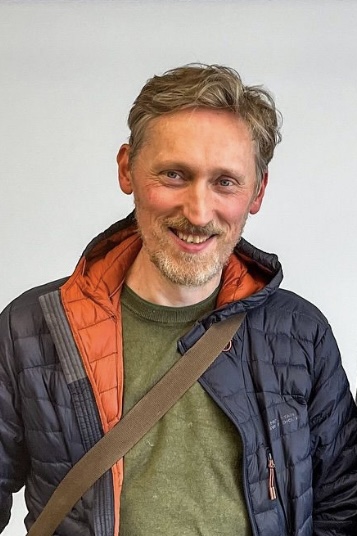
Chris Armstrong is a political theorist at the University of Southampton, UK. He has written on global justice, climate justice, and the biodiversity crisis, but in recent years the ocean has been central to his work. He has published six books, including Global Justice and the Biodiversity Crisis (Oxford 2024), A Blue New Deal: Why We Need a New Politics for the Ocean (Yale 2022), and Justice and Natural Resources (Oxford 2017). He has also spent time communicating to wider audiences about the problems facing the ocean, from environmental destruction to widening inequality. He has appeared on many podcasts and interviews, and written for The Guardian, London Review of Books, the National Maritime Museum, and for the campaigning group Ocean Rebellion.
